Showing posts with label Guest Posts. Show all posts
Showing posts with label Guest Posts. Show all posts
Monday, December 22, 2014
Top Books of 2014 by Erik at "This Kid Reviews Books"


Monday, August 12, 2013
My Guest Post at Joelle Delbourgo Assoc.
Today you can catch my guest post at Joelle Delbourgo Associates, Inc. The article is a "behind the scenes" look at my experiences with my editors at HarperCollins Childrens Books. Find out the difference between story telling and story trapping.
Monday, May 14, 2012
Day 127--Is Self-Publishing For You? By Brooke Warner
The following is a guest post by Brooke Warner, an expert in the traditional publishing and self-publishing industries. I had the pleasure of meeting Ms. Warner in San Francisco at a writers' luncheon sponsored by Hedgebrook. She was a featured speaker on the panel. Ms. Warner has seen over 500 books through the publication process. I'm proud to host her today at The Jennifer (Author) Diaries.
Is Self-Publishing for You? How to Figure Out What’s Right for You in the New Frontier of Book Publishing
I have spent the last thirteen years in traditional publishing, most of them as an acquisitions editor for a major trade press. Since 2007, I’ve also been coaching authors to publication, and the majority of those authors have chosen to self-publish—sometimes because they knew upfront that that’s what they wanted, and sometimes after experiencing rejections from agents and publishers.
What’s clear about today’s publishing climate is that there’s no one right or better way to do things. Whereas ten years ago, self-publishing was a last resort, today it’s the first choice of many savvy and smart authors who want to bypass the publishing industry completely—and oftentimes for good reason.
So how do you decide what to do, and how do you figure out whether traditional or self-publishing is right for you?
The answer to this question is largely dependent on three things:
1. How much you’ve bought into the publishing “dream.”
2. How big of a platform you have.
3. How much you value independence over hand-holding.
4. How many personal resources you have to dedicate to your project.
So let’s look at each of these three things more closely.
1. How much have you bought into the publishing “dream”?
What do I even mean by this? For some people, the dream of getting published on a big house—or on any house—has been with them since they were kids. I’ve met countless authors for whom getting published only means getting published on a traditional house. Some of them are idealistic; others feel that the only measure of their worth as writers can be determined by a gatekeeper—the almighty agent or editor who decides to take on their project; others feel embarrassed by the idea of self-publishing, sensing that spending that kind of time and money on their own project must categorize their book as a “vanity” project and therefore unworthy.
If any of these ideas resonate with you, you’re not alone, but you may need to cut yourself a break, and get a little bit of schooling on how much self-publishing really has changed in the past five years. Now very high-profile people are self-publishing by choice, opting out of traditional publishing altogether for all sorts of reasons, some of which we’ll get into in more depth in point #3 below. Having spent ten of my thirteen years in publishing as an acquiring editor, I can give you the following assurances:
• I rejected many projects I loved, and authors whose stories and writing were phenomenal.
• I turned down authors with amazing books because their platforms weren’t strong enough.
• I rejected books simply because they were too similar to books the publisher I worked for had published within the previous five years.
So, take heart. You won’t always know why you’re being rejected, and it’s worth getting your work assessed by a professional before shopping your book to an agent or publisher, but getting rejected doesn’t mean your work shouldn’t be published, or isn’t publishable.
2. How big of a platform do you have?
This one is important, in part because those authors who are the best candidates for self-publishing are authors who either have a budding platform or a huge platform. So what does this look like? A good platform means that you have a great website. It might have a blog, but it doesn’t have to. If you have a blog, it needs to be well-read, and publishers can check your traffic! You should have a strong social media presence, meaning that not only are you on Facebook, Twitter, and probably YouTube and Pinterest, but you also have a following. Strong numbers on Facebook at this point are anything over 1,000, and for Twitter it’s more than that—maybe 2,500 followers. Remember, I said strong! If you have anything less than these numbers, you might be a person who gets feedback that you don’t have a strong enough platform.
I’ve been making the case for months now that one way to build your platform is to self-publish. Self-publishing your first book is a way to test the waters. It’s a way to gauge interest in your work, and to draw more readers to you and your work. Publishing today is an exercise in marketing. There will always be authors who transcend for one reason or another, who don’t have to promote or just hit a particularly zeitgeist, but this is not the case for the vast majority of us. We have to work our tails off, and you’re no exception. If you know your platform needs work, though, don’t fret. It’s something that’s a slow build. It doesn’t happen overnight, and it doesn’t have to. But in the meantime, you can ask yourself what to do about the book or books you have sitting complete and ready to publish. Do you wait until you have a good enough platform, or do you move forward, self-publish, build a following, and try again for traditional publishing your next time out the gate? Again, this will be driven by your personality and your energy, time, and money, but I’d advise anyone I was working with not to let their project wither while they build. Give it life! See what happens! If you have modest expectations, you will learn a lot, and you can’t fail.
On the flip side of this equation are writers with huge platforms. If you have a massive mailing list and following, the question you might ask yourself is this: Why should I turn over my guaranteed sales to a publisher who is going to take a major percentage of my profits? With self-publishing you generally earn 70% of net profits, whereas with traditional publishing you generally earn about 15%. Yes, that’s a major difference. Food for thought.
3. How much do you value independence over hand-holding?
This one is a biggy. If you don’t want others controlling your content, cover design, and general aesthetic, then you’re a prime candidate for self-publishing. But it’s not always this simple. Self-publishing should, after all, be a collaborative experience. Hopefully, you will not be self-publishing in a bubble, and if you are, you need to stop and seek out support—support from editors, designers, and maybe even a consultant who can help you make some valuable decisions about which self-publishing platform to publish on. There are so many options in the world of self-publishing today, and many hawks out there ready and waiting to exploit authors who don’t know what they’re doing. So be careful, and build a trusted team.
All this said, when you partner with a publisher, they generally have your best interests at heart. They want their authors to be happy and they will often bend over backward to make sure that authors are happy with their process—but not always. If you’re lucky enough to be placed with a house and an editor who get your vision, consider this a blessing. But if you have any reservations about this, you may want to consider your options.
4. How many personal resources do you have to dedicate to your project?
Self-publishing isn’t cheap. When you consider getting edited, finding a designer to do a cover for you, getting the interior of your book laid out, and then the miscellaneous things that are involved—barcode, ISBN, registering with the Library of Congress, setting up your title with your self-publisher, etc.—it can start to build up. And yet, ask yourself what it’s worth. We often think about our personal websites as a calling card, and I’d argue that a book is even more important—in that it needs to be attractive, error-free, and aesthetically feel like a book you would pick up off the shelves at any bookstore. In other words, if you self-publish, don’t do it the cheap way. It’s not worth it. If you have any aspirations of using your book to build your platform, your audience, or your business (even if this business is you publishing more books), invest in yourself!
There are a million resources online that help authors. Take some time to learn what there is to know. Like businesses on Facebook. Like Warner Coaching at www.facebook.com/warnercoaching. People like me are offering countless tips and advice about how to publish, self-promote, market, build your audience, write a great book—you name it. So yes, all of this takes time, energy, and diligence—in addition to the money—but in the end it’s worth it. If you create a well-written and beautiful book, that’s something you have to be proud of forever—and to sell on your website and when you do speaking engagements. Don’t ever doubt that the minute you become an author you become an entrepreneur—if you didn’t consider yourself to be one already.
***
If any or all of these options feel overwhelming to you, there is traditional publishing. Traditional publishing is a process, and it’s very straightforward. If you are a novelist, you must finish your entire manuscript before you start to shop for an agent. You must also create a smashing query letter to get their attention. If you are a nonfiction writer, you must create a nonfiction book proposal, and then you can shop your work either to agents, or directly to a publisher. Navigating the publishing world requires patience, determination, and tenacity, but if you do the research and invest time and money (again!) to make sure you’re going about it the right way, then you have every reason to hope for a successful outcome.
As a person who’s been in traditional publishing for many years, my feelings are almost ambivalent at this point. I have seen authors who’ve gotten published on big houses (who’ve gotten six-figure advances) experience huge failures and disappointment, and authors who’ve self-published (who’ve paid out $3,000-$7,000 to do so) experience major successes, earning back their initial investment and then some.
All of this is to say that no one can give you a perfect road map to getting published. My favorite analogy for publishing is that it’s like applying and getting into college. For those of you living in the publishing “dream,” you’re hoping to get accepted by a Harvard or a Yale. For those of you aiming for a more mid-tier press, it’s like going to a liberal arts or state school. And for those of you self-publishing, it’s a lot like community college. Your experience is what you make of it. And you may be an author who feels too embarrassed to admit that you went to a community college, and yet you know you got a better education there than some of your peers who went to an Ivy League with professors who were so concerned with tenure that their teaching was pretty lackluster.
So it is with publishing. You have to experience it before you know whether you made the right choice, and people can steer you in the right direction—based on your personality, goals, and ideals—but at the end of the day you determine your destiny.
And with that, I bid you farewell and good luck!!
Please don’t hesitate to contact me at brooke@warnercoaching.com if you’re looking for some direction in your own journey to getting published. And I invite you to listen to my audio on the paths to publishing at www.warnercoaching.com/coaching.

Brooke Warner is founder and president of Warner Coaching Inc. (www.warnercoaching.com), where she specializes in helping writers get published. In her thirteen years in the publishing industry, Brooke shepherded over 500 books through the publication process. Her expertise is in traditional and new publishing, and she is an equal advocate for publishing with a traditional house and self-publishing. Brooke's website recently won an award from the Association of Independent Authors for Best Website for Independent Authors. She is currently finishing her first book, What's Your Book? A Step-by-Step Guide to Get You from Inspiration to Published Author. She lives in Berkeley, California.
Friday, April 27, 2012
Book Editing Advice From A Professional
I am proud to introduce a guest post from editor, Neal Hock of Hock's Editing Service. Neal is the editor I hired for my new manuscript, Dead Girls Don't Cry. I invited him to share his expertise with us today at The Jennifer (Author) Diaries!
One of the few things that I remember from a management training class I was in a number of years ago is a discussion about “but” bombs. A “but” bomb is something like “I thought you did a good job, but …” That “but” clause blows up anything positive that you said to the person, because instead of focusing on the praise you gave, the person is focused on what follows the but.
Occasionally, I will peruse reviews on Amazon to see what readers are saying about self-published authors. I can’t help but notice the number of “but” bombs that I come across. You know the reviews that I’m talking about. “I really enjoyed the story, but there were a bunch of typos that distracted me.” “I thought the author showed a lot of promise, but the poor grammar ruined a perfectly good story.” “Interesting concept, but …”
Now, I’m not advocating writing for reviews. But I am saying there are things that you can do to minimize the chance of receiving these types of “but” bomb reviews. Of course, you can hire an editor. But you may have a difficult time finding one to work with you if your manuscript reads like a first draft. Here are a few tools to help improve your writing and eliminate embarrassing mistakes:
- Make sure you have a reliable dictionary. My preferred dictionary is The American Heritage College Dictionary. Other good choices include Merriam-Webster’s Collegiate Dictionary, Random House Webster’s College Dictionary, and New Oxford American Dictionary. Make sure that you have the latest edition, and take a look at the fine print to learn how to effectively use your dictionary. You’re a wordsmith, and there’s no better resource than a good dictionary.
- Make sure you have a reliable grammar guide. There are a number of books available that deal with grammar basics, including The Handbook of Good English; The New Webster’s Grammar Guide; Random House Webster’s Grammar, Usage, and Punctuation; and The Elements of Grammar. You don’t have to become a grammar guru, but make sure you have a solid grasp on the basics and a reliable guide to turn to when you run into sticky issues.
- Make sure you have a reliable usage guide. Usage guides are helpful because there are a number of debatable issues regarding how we use words. A good usage guide will discuss controversial topics that may elicit the attention of the grammar police. One affordable option is Merriam-Webster’s Concise Dictionary of English Usage. Other, more in depth, options include Merriam-Webster’s Dictionary of English Usage, Garner’s Modern American Usage, and The Careful Writer.
- Make sure you have a reliable style guide. The one that I use as my standard is The Chicago Manual of Style, which is widely regarded as the industry standard. While I would recommend that every writer own a copy of it, I realize that it’s probably overkill for most writers. There are a number of reliable style guides available, such as the Strunk and White’s The Elements of Style (which touches on more than just basic style issues) and Merriam-Webster’s Guide to Punctuation and Style.
Don’t let the grammar police arrest your story from the get-go. With tools such as the ones listed above, you can make sure that any “but” bombs you receive are story-related, and not related to the controllable issues of grammar and spelling.

Neal Hock is the proprietor of Hock’s Editing Services (HES). He has edited and proofread over seventy manuscripts, and has worked with small presses and numerous best-selling independent authors in a variety of genres. You can find more information about HES at www.hockseditingservices.com.
Friday, April 13, 2012
14 Tips To Make A Best-Selling Book Cover
Guest Post by C.L. Smith at Humble Nations


iStock
Alternatives: Shutterstock Dreamstime
Free Site: Stock.Exchange
Feeling flush: Getty Images Corbis


 But I don't want to pay for fonts - I hear you cry. No problem there are some commercial fonts that foundries will give away for free - modern, clean, well design. Here are some good links for free fonts, the Posts on Smashing are fantastic - some really excellent stuff there:
My Fonts 40 Fonts Other Smashing Posts Squirrel Fonts

Google Search 86 Beautiful Covers Book Cover Archive (Amazing Site)
Tweetables!
Click to Tweet: "14 Tips to Make a Bestselling Book Cover" @humblenations #ebook #IndieAuthor http://ctt.ec/0QYzw+
Hi, it's Jennifer Lynn Alvarez here, author of the Guardian Herd series. Today I'm proud to introduce C.L. Smith, graphic designer and author. He is generously sharing his knowledge of book cover design. Please check out his website, Humble Nations. Information on how to hire C.L. Smith for your book cover can be found at the end of the article. (re-printed with permission from Humble Nations.)
I have been a professional graphic designer for more years than I can now remember and have designed more things than I care to name: T-shirts, CD covers, packaging, Ebay listing, websites, flyers, posters, letterhead, signage, the list goes on. But strangely enough, until I decided to put some of my own stories on Amazon through KDP, no book covers. Through my lurking on the KDP Forums, and checking out the competition in the last 4 month, I've seen hundreds of terrible, hideous, trashy, horrid, nasty, vomit-inducing book covers that break every rule of good design. Boy these people must really love losing potential readers, I thought to myself at first. But then more kindly, thought well they probably don't know about design.
So rather than being a Mr-Know-It-All, I figure it’s about time I sat down and put some of my thoughts down to help out my fellow writers. My tips are by no means exhaustive and like any art form, design can be a rather subjective subject. So please respectfully disagree - comments very welcome.
But before we begin, let us talk about what design should be, this is easily summed up in one word: functional. So what functions should a Kindle book cover fulfil?
- In the traditional sense, it should stand-out on the book store's shelf saying to the potential reader, "Take me down and have a look inside of me."
- It should set the mood for the story (the Vintage Murakami Covers a perfect example).
- Establish a brand (if part of a series).
- Show that there is a high-level of quality in the writing. If a cover is poor then the potential reader will not have high hopes for the writing.
1. Photos: Set The Mood and Don't Be Literal
The worlds of the visual arts and the written word collide on a book cover, and this is the first real big problem we run in to. If we are talking about fiction, the reader dreams the world in their head from the words the writer has put down on the page. The moment you put something too literal on the cover you run into the problem of the reader having that image in their head. It spoils the glorious affect reading gives us. If you have selected an image that simply tells us what a character or a place looks like you have made a mistake. You might say to yourself - but the photo I have found looks exactly how I see the characters in my head - can I not use it? Well, I'm sorry, no you can't, that's rude - you're taking away the reader imagination from them.
Literal pictures should be avoided at all costs. So, you want to use a photo, but don't want to be literal - what can you do? It's simple use the image to set the mood. Make it abstract. Take a step sideways – as a writer you should already have these skills in your toolbox – the simile and the metaphor. Use these to come up with a good metaphoric or abstracted cover.
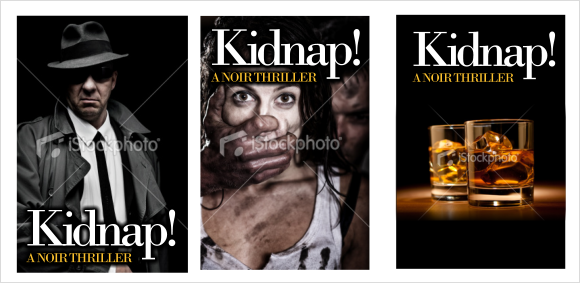
The above example is a Noir Pulp thriller I’ve made up called Kidnap! Avoid the obvious: if we have a victim on the cover, we’re seeing what she looks like before we’ve even discussed her in the book, we’ve given the game away; likewise if we have a Private Detective on there, we’re saying, he looks exactly like that (it’s lazy, it’s as bad as Dan Brown saying the hero in The Da Vinci Code looks a bit like Indian Jones – before anyone tells me out there that yes he did say that in the novel – I know).
So in this instance I have abstracted the concept of the hard drinking PI – and thought something ominous and dark that fits – right, whisky moodily lit. That image took all of 5 minutes to find on iStock. It works, it’s simple strong and gives a flavour of the story.
Here are some more examples, I quickly knocked up some imaginary covers of mood setting ideas. Each gives a feeling for what the book will be like rather than telling.

2. Photos: Avoid Stocky Stock
I don’t know how I can explain this well to none-designers. But there are some images out there which just have the feeling of stock images. The top right example above might be one, something that everyone would think is cool and is used over and over again – because it’s so obvious. As well as the written cliché, there is the visual cliché. As a good example, there’s a famous case of a stock image that has been used for so many different album covers it’s untrue – yes it’s a nice image – but when you find certain images you know they’re going to be re-used. I think we should leave the explanation of this particular no-no to another designer I admire – he’s very eloquent on the subject of avoiding stock clichés.
3. Photos: Pay For What Works
If you don’t have permission to use a photo or you don’t know who owns it, then chances are you can’t use it. Would you want someone stealing your writing – you need to show the same respect to your fellow artists; the photographers. Having said that, there are free places out there to get photos but you will end up getting what you pay for: poor images.
Fear not, there are some very cheap effective solutions – my favourite for commercial work is probably iStock because they have excellent quality control and a vast archive of images. Their pricing is also resonable, you're looking at $2-$10 or something of that order, depending on what size of image you want from them. Their "terms of use" allowed you to use any images on you cover upto selling 499,999 copies. If you’re selling more – you’ve really designed yourself a good cover and written yourself a good book.
iStock
Alternatives: Shutterstock Dreamstime
Free Site: Stock.Exchange
Feeling flush: Getty Images Corbis
4. Photos: Don't Create Composites
Unless you are master with Photoshop (or it’s free equivalent GIMP), then I would steer well clear of this technique. Photos are lit from different angles, have different colour saturations and styles. Let me tell you what lots of images put together on a single cover will look like: like you have cut pictures from different magazines and glued them onto a piece of paper – and unless the theme of your book is Scrapbooking, it will look amateurish and denigrate the quality of the masterpiece you have written. Is your novel a jumble of styles? Does it skip around in tense? Have you just thrown words down randomly? No, I thought not. So don't do it on the cover because otherwise that's the message you're sending out.
Another thing you need to consider is the more complex your image is the harder it will be make out on the thumbnail.
On great image is more powerful than 5 different ones about your book.
5. Avoid Home-made Drawings
There are very few people that are as talented at drawing as they are at writing but there is a temptation to want to write, act-in, direct and compose the music for your own film; and say to yourself - I can paint an amazing cover, sitting down with some water colours then scan your creation and use that. Or get your friend who is just "brilliant at drawing" to draw a picture of the main character or a scene. This too is a no-no. You might think it gives it a personal feel. But that's just what it will feel like, some sort of craft-circle vibe. People are judgemental; they won't even bother looking at your writing if they feel the cover is poorly drawn by an amateur. So what if you do want a drawing rather than an photo, it's not a problem, those stock sites I listed above have illustrations as well - all quality controlled. Pay a few dollars and get something professional that fits. Here are some examples I quickly knocked up using stock drawings:

6. Layout: Colours
Here's were we run into big problems. It's very hard for me to teach you how to use colour well. It's something that you feel, it's something that you need to experiment with with over and over again to get colours to gel well together. I've been designing for more than 20 years and I still only just feel I'm getting to grips with it. My advice here would be to use a some software that allows you to change the colour on-the-fly as you're designing your cover. I personally use Xara Xtreme Pro Version 4 - which is a vector application from years and years go - to design. It's just what I'm used to. But the simplified advice I would give is this:
- If you use something bold have something that contrast.
- Don't use more than 3 colours.
- Avoid primary colours you find on MS Paint (full blue, full red, full green).
- Mix your own colours yourself - shades of strong colours.
- Find out what colours work by testing testing and testing again. Try different combinations next to each other to see what works.
- Google 'Beautiful Colour Palettes' 'Colours That Work Well Together' or something similar.
I've been working on my own covers for my short stories and they're from all around the world, so I have a starting point for my palettes because I am using a colour for the flags of each country. But then I want something bold and attractive that stands out. They might look simple but I can spend anything up to a hour fine tuning the colour on one cover, so it really looks works for me.

7. Layout: Don't Be Afraid of Space
Like colour, when it comes to designing layout, it's a lot of trial and error until something just looks right to you - looks balanced. But one of the main problems that I've seen a lot with covers I've come across is that people think because it's going to be a thumbnail it must fill the whole of the canvas. With design what happens is, the eye is naturally drawn around what it is seeing; all the elements compete for priority. The best way for a design to work is to give the elements lots of space to breath. It's no different to writing - if you put in too many complicated words or adjectives in the same sentence, or too many elements into a metaphor or simile it becomes confusing. Good writing is balanced by space. So is design. On the design below, the right design is the final design design, but a designer worried about using all the space might do something similar to the left or middle. I'll let you make up you mind which has the most style and sets the best mood for a short story.

8. Type: Use Commercial Fonts
There is a temptation to use a font that "looks cool" downloaded from somewhere like Da Font, like a nice horror style font for your vampire book. As well as fitting into the "no-no" of being too literal, the greater consideration is the quality of the tools you're using: free home-made fonts are usually designed very badly themselves - not weighted properly, illegible at small sizes (think about the thumbnail), not kerned or spaced properly. I would avoid them at all costs. Always go for something classical, clean and easy to read. It makes all the difference. You might think the two first options, in this speedily put together example below, look cool! But if you can't read the title straight away they're not functional - as design they don't work: design should always be functional as well as aesthetically pleasing.
 But I don't want to pay for fonts - I hear you cry. No problem there are some commercial fonts that foundries will give away for free - modern, clean, well design. Here are some good links for free fonts, the Posts on Smashing are fantastic - some really excellent stuff there:
My Fonts 40 Fonts Other Smashing Posts Squirrel Fonts
9. Type: Don’t Be Afraid of Typesetting Only
“Do I have to have a picture on your cover?” This is a questions none of your have probably thought of asking. That would just be boring wouldn't it. What no picture?! Think again. If something is typeset nicely it can just be effective as good design. And can be powerful and arresting. For book covers, a little voice in my head says, "CL this is the best option because it says – this book is about words." How more conceptually correct can you get? It all comes down to selecting the right colours, using the right fonts, and spacing them nicely (my top tip is learn about kerning). The examples below are typeset cover I found on the Book Cover Archive that I liked:

10. Type: Using 3D Effects & Drop Shadows
If you look on the above examples, you'll see that none of them have 3D Effects, Drop Shadows or any other special effects on them to make them look "cool". There's a very good reason for this, you might think 3D Effects and Drop Shadows make your text stand out - but this isn't the case, it actually makes the design more complex - harder for the eye to understand. If you want your text to jump off the page then pick the right colours and a nice clear font. If you are using gimmicks to try and make your design sing, because it's not standing out, then it's more likely a problem with your colours or font, you need to go back to the drawing board and pick new ones. Experiment. Experiment. Experiment.
11. Type: Size & Placement
There are no hard and fast rules about where you should put your text and what should be given more prominence. But I would say this, to make a memorable or engaging cover - your name, the name of the author doesn't have to be in massive letters on the front covers, as I see a lot. You might say - yes, but I want people to remember my name. People will remember your name from becoming famous for your writing, not for your name itself. In a way the bigger the name, if you're not well established, the more egotistical and desperate to be famous, it makes your look: it might work for James Patterson or Dan Brown or Ben Elton when they're all vying for attention in an airport book store. Likewise, is the novel title that important - not necessarily so. It's all about what you want to say with your cover. And I would take it back to that simple mantra - the most important thing is to set the mood - so someone gets a feeling for the writing and entices them to 'Look Inside' or click 'Buy'. Does your name massive on the cover do this if you're not famous? I think not.
12. Take Inspiration From The Past
Like all good artists - whether they are graphics designer, painter, musicians or writers - we will steal a little inspiration from elsewhere. We are affected by other people's work we enjoy. To this end there's nothing wrong with finding a style you like and coming up with something similar. The only thing you need to make sure of is that you're not just lifting their images and taking their design wholesale. So people confuse the two covers and your run into copyright issues. But here are some great starting points to see some of the best cover out there. The really "amazing site" has links at the bottom of the page to yet more great sites with covers on them.
Google Search 86 Beautiful Covers Book Cover Archive (Amazing Site)
13. Remember: Keep It Simple
As as finally point here, I would say this, the strongest point I can make is this - good design is simple, or based on a simple concept - it's no more relevant than on Amazon because you have small images in the thumbnails, lots of products vying for attention and lots of messy, badly designed covers - so your simple clean designed cover will shine like a diamond in the junk yard of mess - if you follow the ideas covered above.
And if all else fails …
14. Get a Professional In
You can have all the tools at your disposal: good fonts, the time to mess about with colours and spacing, bought the perfect mood-setting image but still come up short on your design and it might not look right. This is because you're not a designer. You're a writer. You've perfected your own craft - maybe over years and years. It's no different with graphic designers - they've worked long and hard to get to the point where they're at: collected ideas in their head, always thinking visually; paid thousands for fonts over the years; developed a perfect eye for what looks right. There are plenty of good designers out there. Picking the right one could be difficult. But I would proffer this as a piece of advice: If you are going to shell out for a nice cover for your little baby make sure they ask you the right questions. What a good design should be asking:
- What feeling are you trying to get across in the book (name three emotions you'd describe your books as)?
- Is there an item or concept that is thematic in the piece?
- What sort of colours do you see the book as?
- Are their any great covers from books you have seen that you like?
- If you book was a famous film what would it be?
A good designer will always confidently ask the right questions before starting work because otherwise they're wasting their time and yours.
Is it worth paying $100 or $500 for good cover design?
Well that's all down to you. If you think your book is good enough and it would double your sales because it's eye-catching and makes your look professional - you have to ask yourself if you're going to sell more than a hundred or a thousand copies of your book - if not, it's just vanity to pay someone to design a cover. But on the other hand, if you are selling lots of books with a bad cover, then chances are the right cover will allow lost potential readers, who have been put off before, to judge a book by it's cover and make a purchase because they see quality from the get go.
If you're interested in getting me to design for you, I am more than happy to, I charge $150 for one option to pick from, $200 for three options to pick from, and $250 for five options to pick from. You can chat to me about your requirements at humblenations@gmail.com.
To Do: Evaluate your book cover. Use a community forum to get unbiased advice and opinions. If it doesn't measure up, fix it or contact Humble Nations for a makeover!
Tweetables!
Click to Tweet: "14 Tips to Make a Bestselling Book Cover" @humblenations #ebook #IndieAuthor http://ctt.ec/0QYzw+
Friday, February 24, 2012
Six Steps for a Successful School Speaking Presentation
Six Steps for a Successful School Speaking Presentation
by Molly Snow
When I was twenty, I worked for a world-renowned speaker who was paid to motivate business men and women in audiences of hundreds or thousands. I considered her to be pretty fearless. I had only given an occasional talk in class or church. It was nothing in comparison to what she was doing. After I worked as her personal assistant for a while, I spring boarded off on my own adventures. I, too, wanted to be an author. I, too, wanted to be a speaker. I had no idea that both those opportunities were just around the corner. This post is to share with you what I have learned about speaking in front of large crowds.
After I self-published my first novella, BeSwitched, I did a signing at a local book store. There I was approached to speak at a local elementary school. Of course, when I was offered to speak and for money, I didn’t hesitate to accept. Even though I had no experience with giving assembly presentations to hundreds of kids, I knew that since the opportunity came my way, then I must be ready or I would make myself ready.
What happened at first was a feeling of disbelief and having gotten myself in over my head. How would I suddenly become a speaker? I could communicate with people well enough, to the point that I could even story-tell, but how was I to keep the attention of my audience--which would consist of hundreds of children?
If you’ve read anything on marketing whatsoever, then I am sure you have come across the first rule—“Know your audience.” I knew my audience, I thought, but did I really? It had been quite some time since I was a child. I did my best to place myself in their shoes. I remembered back to when I was a kid. What books were my favorites? What did my journal say about meeting an author for the first time? I started to dig into my history, even finding a poem I had written when I was in the 5th grade about my dream to one day be an author.
 |
| Author/Speaker, Molly Snow |
I then wrote down ideas of what I could share that would involve my audience’s participation, even if it meant just getting them to raise their hands, or close their eyes in imagination. What could I teach them? What exercises could we do together? Eventually, I was able to outline a basic construct of my assembly presentation into parts.
I’ve laid out the 6 steps of my successful school assembly presentation for you:
- Getting to know you time. Share what you were doing at their age or in their position? How do you relate to them through your assigned topic?
- Talk about your book and read an excerpt.
- Teach them something.
- Do an exercise to motivate. (You can use Powerpoint, an overhead projector, music, and so forth. The important part is to try and get quite a few, if not all, the audience involved.)
- Have them accomplish something with you.
- Wrap up with Q&A time.
Remember that you can turn your nervousness into excitement. Use that energy to share your happiness with your audience. Always look glad and grateful for the opportunity. Thank the audience and those who booked you. Be an example to those who want to one day be in your shoes. And lastly, you don’t have to be perfect, because nobody is perfect. If you taught your audience something new and brought them a sense of excitement for their future, then that’s good enough.
 |
| Inspired Students! |
After your first speaking engagement, don’t be surprised if you are invited or referred to other speaking engagements. Be ready for these moments. Put on your website and business card that you are a speaker. Actively promote yourself to other businesses or schools who may not know of you and your speaking experience. Since my first speaking engagement, I have been invited to over a dozen more. Relish the moments.
Speaker Molly Snow is the author of The BeSwitched Series and Founder of Breezy Reads. She grew up in the Bay Area, is married to her high school crush and has a set of silly twin toddlers. Learn more about her at http://mollysnowfiction.blogspot.com
To purchase Molly Snow's Books click on the photos below!


Thank you, Jennifer, for having me.
Friday, February 10, 2012
Book Marketing: Back to Basics
Book Marketing: Back to Basics
First, a big thanks to Jennifer for asking me to guest post on her blog today. I know Jennifer has been working very hard on marketing her own book, The Pet Washer. As an independent author of three books myself, I know how discouraging that can be. What I mean by that is as an independent author, we wear many hats. Not only are we the author, but we are often the editor, the book cover designer, the formatter, the distributor, the salesman, and the book marketer too! All of this can be quite a struggle. So, when Jennifer asked if I'd provide a few marketing tips for her and her readers, I was happy to help!
Before any author considers publishing independently, if they asked me for one piece of advice it would be to make sure their book is available as an Ebook and is formatted properly for E-distribution. Many reviewers these days use an Ereader and will accept a free PDF, mobi, or epub file so that you don't have to mail them a physical copy. This saves you postage and saves you from having to invest in lots of physical copies. And with E-Publishing being the mainstream these days, your book should be available for all devices. Kindle and Nook are the main two, but you can also make your book available on iTunes and other platforms just by publishing through www.smashwords.com.
I'm not saying you shouldn't invest in any physical copies at all! I'm a big believer in having copies of your own book on hand. When I started marketing my most recent book, I went to www.goodreads.com and offered 5 copies as a give away. Almost 900 people signed up to win a copy! And although the give away was in 2010, my book is still on 142 to-read lists at GoodReads to date. If even half of those 142 people eventually bought and read my book, and maybe posted a review of it on GoodReads, then I'd say the investment in those 5 copies was well worth it. For more tips on what to do with physical copies of your books, read this article I wrote for LL Book Review called Top 26 Places Where Your Book Should Be.
Speaking of GoodReads, if you aren't a member already then you should sign up. It's like Facebook for readers and authors! Authors can create their very own fan page and even Q&A forums for their readers. Social networking sites like this, Facebook, and Twitter are essential when it comes to connecting with readers these days. My only advice here is to be interactive with your readers and subscribers, post regularly, and don't try to be a pushy businessman who’s just trying to sell books. Keep things fresh and exciting to make your book stand out! Post about the writing process. Do interviews with your characters. One of my author friends tweets as the lead character of her YA series. Jennifer here has devoted her site to blogging about a marketing endeavor every day. Ideas like this definitely help to keep readers interested in you and your work.
Let's not forget that dreaded word: REVIEWS! Getting reviews for my book has always been a top priority on my list when it comes to marketing. I've actively sought out reviews by contacting friends and colleagues, offering them a free Ebook or hardcopy. I've also regularly contacted book blogs and reviewers at sites like bookblogs.ning. Whether they post their review on their own site or at Amazon, every review provides you an opportunity to tweet about the review, mention it on Facebook, or post on your blog. In turn, you’re sending traffic to that reviewer's site and they are sending traffic to your book!
Based on the ideas I've given you today, I know what you are probably thinking: "We sure are giving a bunch of books away!" While marketing can be discouraging, an independent author should not get discouraged if they don't see an immediate return in sales. The joy of publishing your own book, first and foremost, should be that you've gotten someone to read it. As one of my favorite authors, W.H. Auden, once said, "A real book is not one that we read, but one that reads us." Nothing excites me more than getting an email or talking to a reader who had a connection with one of my books or characters. That's fuel enough to keep me going and it's nice to be reminded that you are a good writer. And that's a good enough reason not to give up.
Shannon Yarbrough is the author of three novels: The Other Side of What, Stealing Wishes, and Are You Sitting Down?. He is also the founder and lead reviewer of The LL Book Review, an indie review site dedicated to self-published authors. Visit him online at www.shannonyarbrough.com.


Click the images above for more details about Shannon Yarbrough's books or to purchase!

Tuesday, February 7, 2012
How to Price an eBook
How to Price an eBook
Guest Post by Tahir Yaqoob
First of all, thanks to Jennifer for the invitation to present this article on her blog and help with this article. As the eBook revolution continues to gain momentum, the question of eBook pricing strategy and models comes up frequently. The ultimate goal being to discover the optimal retail price for maximum eBook revenue.
On the one hand revenue is proportional to the retail price and number of books sold in a given amount of time, but on the other hand, the number of eBooks sold in a given amount of time drops as the price increases. There is a trade-off such that there is some optimal price that gives the maximum revenue.
This is actually a standard calculus problem and what I'm going to show you is a remarkably simple result. However, there are caveats, and ultimately, nothing can beat real measurements and data.
In an ideal world you would do a controlled experiment over a sufficiently long period of time to eliminate statistical fluctuations. You would measure the revenue as you change the price and thereby estimate the optimal price.
However, in practice, you very likely don’t have the time to do that, and even if you did, there are so many factors that affect sales that it would be extremely hard to account and correct for those factors.
Still, I think the result I'm going to show you serves as a baseline guesstimate for orientation purposes. I would not recommend basing your marketing plan on this alone! Every book is unique and every book's situation is unique.
I'm only going to deal with the case of Kindle books priced between 2.99 and 9.99, otherwise this article would be way too long and complicated.
Sales vs. Price: Five Cases
 |
| Figure 1 |
Case A: The horizontal dotted line is a no-brainer: sales are flat, so the optimal price is the highest price.
Case B: You may think this is strange but here the number of books sold goes up before it goes down: this is appropriate when the book's quality is perceived to be low if the price is too low.
Case C: Here the number of books sold stays fairly flat until some critical value, after which it drops. This is probably the case relevant for the majority of eBooks.
Case D: Here the number of books sold drops continuously in a straight-line fashion between 2.99 and 9.99.
Case E: Here the number of books sold plummets dramatically when you raise the price above 2.99, but then the rate of plummeting slows down.
The Main Result
What is interesting is case D, because some basic mathematics leads to a remarkably simple result. I am going to tell you what that result is and then I'm going to show you why it is true without using equations, but rather, I will show you how the result can be understood intuitively. Then I will illustrate with a specific example with some numbers. So, here is the result:
If you can estimate (or establish) the price at which your sales drop to zero, all other factors being equal, the price that will return the maximum revenue is precisely half of that value.
In other words if case D applies, and if, for example you estimate that your sales would first drop to zero at $15, your optimal price is $7.50.
What is remarkable is what this result does not depend on. It does not depend on any actual sales numbers at any price; and it does not depend on the royalty rate, as long as it is the same from 2.99 to 9.99. It actually depends on one thing only and nothing else, and that is, the price at which your sales first drop to zero.
How to Apply the Result
You probably have a fairly good idea of what that price would be without doing the experiment. You could also estimate it as some percentage above the highest price of your book's closest competitor. (If you think that your book has no competitor, think again: what is relevant is perceived competition, and every book has that, otherwise people would be lining up outside your house with their check books!)
If it is a Kindle book your estimate can be up to $20. If it is more than that, then you have to choose $9.99 as the price of your book, unless you want to drop your royalty rate to 35 percent, which would not make sense.
If it is a Kindle book your estimate can be up to $20. If it is more than that, then you have to choose $9.99 as the price of your book, unless you want to drop your royalty rate to 35 percent, which would not make sense.
Why It’s So
So, what is the fundamental reason for the simple “rule of thumb?” Well, your net revenue is the product of something that depends on the retail price (royalty times price), and something else that depends on price (i.e., the number of books sold drops with price). Therefore, you get a “price squared” in the net revenue equation.
Now, the graph of anything squared (for which the variable has no higher power than a square) is a parabola, or upside-down “U.” But we know that the parabola must go through zero at a retail price of zero (i.e., at zero revenue), and it must go through zero at the price we estimated the number of books sold to drop to zero (by definition, obviously).
But hang on, a parabola is symmetric around the peak or hump! So the peak must lie precisely halfway between the two zeros! Remember that this only applies to “case D” and it does not apply to paperbacks, which have a completely different pricing and revenue structure.
Caveats
There are many caveats but a major one that the above does not take into account is the exponential effect of the Amazon ranking machinery, which will directly affect results.
Basically, the more units you can move in the shortest time, the more Amazon rewards you with increased exposure, regardless of price. This effect will skew the optimal price below the baseline.
An Example with Numbers
Now, to pull all this together, here is an example with some numbers. Fig. 2 shows a line corresponding to revenue versus retail price per book (this is just the royalty rate times the retail price; I have used 70 percent royalty here but it doesn't matter).
 |
| Figure 2 |
In Fig. 3 is a made-up example of number of books sold versus retail price (assuming "case D"). In this example we estimate the sales to drop to zero at $15.
 |
| Figure 3 |
Now we multiply the graphs in Fig. 2 and Fig. 3 together to get the net revenue versus retail price and this is shown in Fig. 4.
 |
| Figure 4 |
You can see that the maximum revenue occurs at a retail price of precisely half of $15, as expected. You can then use this baseline as a guide to figure out what the ideal price might be for your unique situation.
Summary and Take-Away
The main thing is, don’t take this too literally: the optimal price problem is extremely complex. However, I have shown that you can calculate a baseline number to work with by estimating the price at which your sales would drop to zero: half of that price is the optimal baseline.
Good luck with your publishing adventures: remember that the main goal is to enjoy what you’re doing day-to-day, not just the end result, because you are in it for the long haul!
"Tahir Yaqoob is an astrophysicist & educator with over 25 years of experience. He obtained a B.A. in physics from the university of Oxford, England, and a Ph.D. in astrophysics from the University of Leicester, England. He has authored or co-authored over 120 research papers in peer-reviewed journals and is the author of two books, What Can I Do to Help My Child with Math When I Don't Know Any Myself?, and Exoplanets and Alien Solar Systems, which makes the exciting new science of planets beyond our solar system easily accessible to the layperson. Both books are available in eBook and paperback formats."
"Tahir Yaqoob is an astrophysicist & educator with over 25 years of experience. He obtained a B.A. in physics from the university of Oxford, England, and a Ph.D. in astrophysics from the University of Leicester, England. He has authored or co-authored over 120 research papers in peer-reviewed journals and is the author of two books, What Can I Do to Help My Child with Math When I Don't Know Any Myself?, and Exoplanets and Alien Solar Systems, which makes the exciting new science of planets beyond our solar system easily accessible to the layperson. Both books are available in eBook and paperback formats."


Click the images to view more details about the books or to purchase!

Subscribe to:
Posts (Atom)